Updated for July 2026
Dimensional weight divisors for USPS, UPS and FedEx in 2026
USPS now divides by 139, the same number UPS uses on Daily Rates and FedEx uses on U.S. package services. It changed on July 12, 2026, and some pages, a few of USPS's own among them, still say 166.
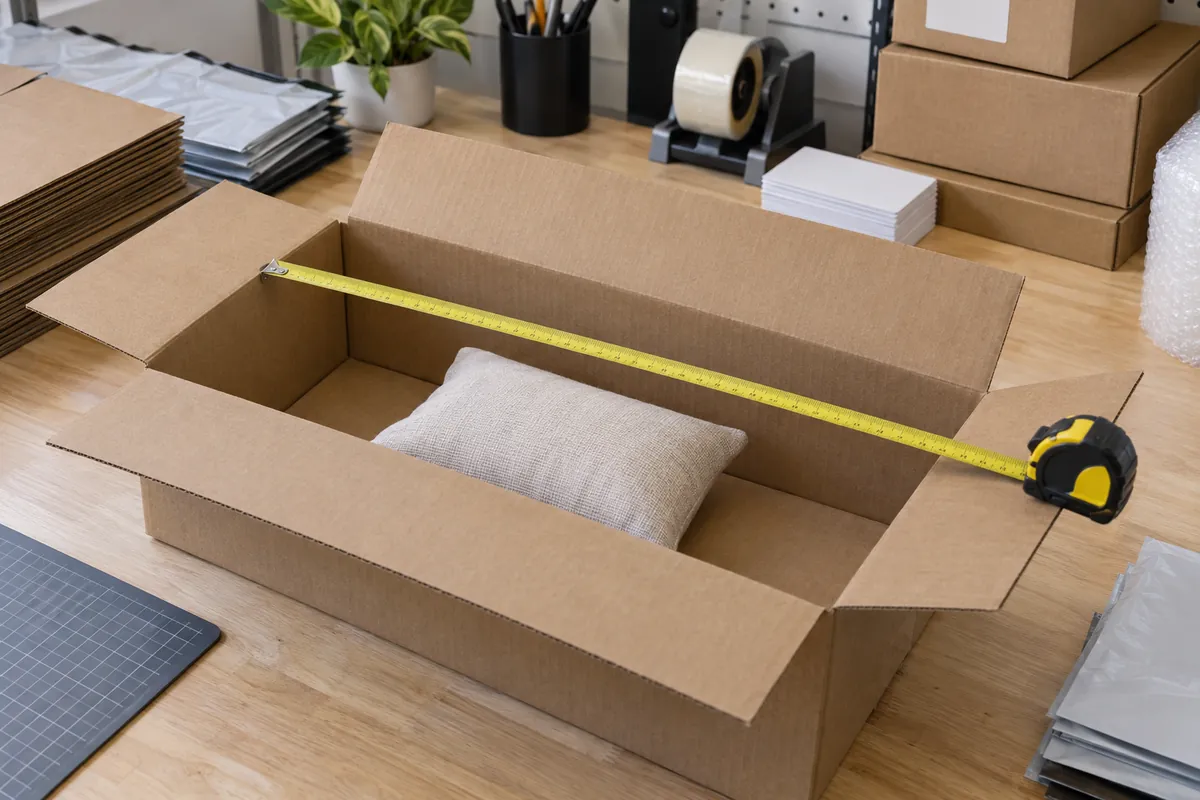
Dimensional weight is a price weight worked out from a box's size: length × width × height, divided by the carrier's divisor. The carrier bills whichever is higher, that number or the scale weight. The divisor decides how hard a big, light box gets hit, so the wrong divisor gives you the wrong shipping estimate on every big, light box you list.
What divisor does each carrier use in 2026?
As of September 2026 the published divisor is 139 at USPS, at UPS on Daily Rates, and at FedEx. UPS Retail Rates, what you pay at a UPS Store counter, use 166. USPS is the only one that skips dimensional weight on small boxes. It applies it only above 1 cubic foot.
| Carrier and rate | Divisor | When it applies | Rounding |
|---|---|---|---|
| USPS: Ground Advantage, Priority Mail, Priority Mail Express, Parcel Select | 139 | Only boxes over 1 cubic foot (1,728 cubic inches), zones 1-9 | Each side up to the next inch, result up to the next pound |
| UPS Daily Rates (a six-digit UPS account opened since July 11, 2016, or Daily Rates by agreement) | 139 | Any size | Each side up to the next inch, result up to the next pound |
| UPS Retail Rates (shippers who don't get Daily Rates, including packages processed at The UPS Store) | 166 | Any size | Same as Daily Rates |
| UPS Small Business Rates accounts | 166 | Only boxes over 864 cubic inches | Same |
| FedEx (U.S. package services) | 139 | Any shipment in your own packaging | Each side up to the next inch, weight up to the next pound |
| eBay Labels, per eBay's own guide | USPS 139, UPS 166, FedEx 166 | eBay says UPS and USPS bill it only over 1 cubic foot | Round up |
Sources: USPS DMM 283 and DMM 133 (text marked 7-12-26), the UPS Daily Rates guide (updated September 7, 2026) and Retail Rates guide, the UPS dimensions and weight page, the UPS Small Business Rate Guide (effective January 26, 2026), the FedEx Service Guide 2026, and eBay's dimensional weight guide for sellers. All checked September 23, 2026.
What changed at USPS on July 12, 2026?
On July 12, 2026, USPS dropped its divisor from 166 to 139 and began rounding each side of the box up to the next whole inch instead of to the nearest inch. USPS announced it in a May 12, 2026 advisory, saying it would “align the divisor for dimensional weight pieces to industry standards.”
Both changes raise the bill on the same box. A 12.2-inch side used to count as 12 inches. Now it counts as 13, and that's the exact example on USPS's own Ground Advantage page.
| Before (divisor 166) | Since July 12, 2026 (divisor 139) | |
|---|---|---|
| Packed box | 16 × 12 × 10 in, 2 lb | 16 × 12 × 10 in, 2 lb |
| Volume | 1,920 cubic inches | 1,920 cubic inches |
| Dimensional weight | 1,920 ÷ 166 = 11.57, bills as 12 lb | 1,920 ÷ 139 = 13.81, bills as 14 lb |
| Billable weight | 12 lb | 14 lb |
This example uses whole-inch sides and leaves price out, because the price also depends on the zone and the service.
Why do some pages still say USPS uses 166?
Because some of USPS's own pages still print 166, the old number is easy to find. As of October 2, 2026, USPS's Quick Service Guide for retail Priority Mail (QSG 120) still divides by 166 in its worked examples. A USPS FAQ on Priority Mail still says dimensional weight applies only in zones 5-8. The Domestic Mail Manual, which is the rulebook, says 139 and zones 1-9.
If a tool gives you 166 for a USPS label, it's out of date.
Does USPS charge dimensional weight on small boxes?
No. USPS applies dimensional weight only to boxes over 1 cubic foot, which is 1,728 cubic inches, going to zones 1-9. A 12 × 12 × 12 box is exactly 1,728 cubic inches, so it pays on its scale weight. Measure carefully, though. One side at 12.1 inches counts as 13, and that puts the same box over the line.
UPS and FedEx have no size floor on their standard rates, so a small, light box can still bill on size with them. USPS also caps the charge: if the dimensional weight comes out over 70 pounds, you pay the 70-pound price (DMM 283.1.4.2d).
Which divisor applies when you buy a label on eBay?
eBay's own shipping guide lists 139 for USPS labels and 166 for UPS and FedEx labels bought through eBay. It also says UPS and USPS bill dimensional weight only when a package is over 1 cubic foot. That's eBay's statement about its label rates, and it differs from the divisors UPS and FedEx publish for their own accounts.
eBay's calculator and eBay Labels price the box from the weight and dimensions you type in. If the carrier measures something bigger or heavier, eBay typically charges you the difference afterward. eBay's Seller Center says so on its packaging and measuring page.
How do you calculate dimensional weight?
Dimensional weight is the box's length × width × height, divided by the carrier's divisor. As of September 2026, USPS, UPS and FedEx all round each side up to the next inch first and round the result up to the next pound. The carrier then bills the higher of that number and the scale weight.
- Measure the packed boxTake the longest side as the length. Measure each side at its widest point, bulges included, after the box is taped.
- Round each side upUSPS, UPS and FedEx all round any fraction of an inch up. 10.2 inches is 11.
- Multiply the three sidesThat's the volume in cubic inches.
- Divide by the carrier's divisor139 for USPS, UPS Daily Rates and FedEx. 166 for UPS Retail Rates and for UPS or FedEx labels bought on eBay. Round the answer up to the next pound.
- Compare it with the scale weightRound the scale weight up to the next pound too. The carrier bills the higher number. For USPS, skip the size math if the box is 1,728 cubic inches or less.
The dimensional weight calculator on this site does these steps with each carrier's divisor and size floor built in.
How do you keep a box from billing on size?
A box stops billing on size when its volume divided by the divisor is no more than its scale weight. At USPS the simplest fix is getting the packed box to 1,728 cubic inches or less, because USPS skips dimensional weight at or under 1 cubic foot.
- Use the smallest box that fits the item safely. Volume multiplies three sides. Take one inch off each side of a 16 × 12 × 10 box and it drops from 1,920 to 1,485 cubic inches, under the USPS line.
- Use a poly mailer for soft goods. There's almost no air to pay for. On UPS a soft pack over 18 × 14 × 6 inches adds an Additional Handling charge, and on FedEx the line is 18 × 13 × 5 inches.
- Price small, heavy boxes as cubic. Ground Advantage Cubic prices boxes up to 1 cubic foot and 20 pounds by size tier, not weight.
- Measure the box, not the item. You're billed on what the packed box measures, bulges and all.
Enter the packed box's weight and size when you list. eBay's calculator and eBay Labels price from those numbers, and the carrier checks them.
FlowLister, which the team behind this site makes, writes the shipping into the listing when it builds the listing from photos. It's AI and it misses things, so put the packed box on a scale and a tape measure before you ship.
What is the USPS dimensional weight divisor in 2026?
What dimensional weight divisor does UPS use?
What dimensional weight divisor does FedEx use?
Is dimensional weight the same on eBay labels?
Disclosure Shipping for Sellers is published by the team behind FlowLister, AI eBay listing software that turns item photos into complete eBay listings, shipping included. It's AI, so it misses things: weigh and measure the packed box before you trust any shipping number, ours included. We make FlowLister, so read this as a disclosure, not a recommendation.
Keep reading
USPS Ground Advantage Cubic: priced by size, not weight
Up to 20 lb, 1 cubic foot and 22 inches, priced by size. When it beats weight pricing, with USPS prices.
USPS Ground Advantage vs Priority Mail for sellers
Ground Advantage is cheaper and slower. The 2026 prices side by side, plus when UPS, FedEx or eBay's envelope wins.